- February 15, 2026
Simplified QuickBooks Accounting for Shopify & Amazon Sellers


How to Register for Sales Tax in 45 US States in 2026

How to Register for Sales Tax in 45 US States in 2026
Meet Sarah. She launched her Shopify store selling handmade candles. Sales exploded during the holidays—$150,000 in one quarter. She thought, “Amazon handles tax on my FBA listings, so I’m good.” Then the letters started. California demanded $18,000 in back taxes plus penalties. Washington hit her with a $4,500 fine for missed filings. Sarah spent weeks in panic, hiring a lawyer, and nearly shut down. Her story? All too common.
US e-commerce sellers face a big task. Forty-five states charge sales tax. Only Alaska, Delaware, Montana, New Hampshire, and Oregon do not. Economic nexus rules mean you must register when you hit sales thresholds—even without a physical office. Registering keeps you compliant. It avoids penalties and account freezes. This guide shows you how. Follow these steps to handle multi-state sales tax registration—and avoid Sarah’s nightmare.
Why Sales Tax Registration Matters for E-Commerce
Economic nexus kicks in after you reach a state’s threshold. Common triggers include $100,000 in sales or 200 transactions. Amazon FBA warehouses create physical nexus too.
Once you have nexus, register for a sales tax permit. This lets you collect and remit tax legally. Skip it, and states can charge fines or back taxes.
Take Mike, an Amazon FBA seller. He crossed $100k in Florida without registering. A surprise audit two years later cost him $22,000 in back taxes, interest, and penalties. He said, “I thought Amazon covered everything. I was wrong—and it almost bankrupted me.”
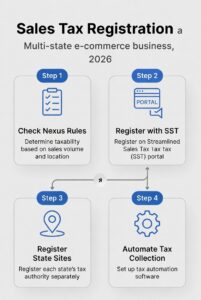
Step 1: Check Your Nexus First
Do not register everywhere at once. Find where you have nexus.
- Review sales data by state.
- Use tools like TaxJar, Avalara, or TaxCloud for automatic tracking.
- Check Amazon Seller Central for FBA locations.
List states where you exceed thresholds. Start with high-volume ones.
Jake did this early. His WooCommerce store hit nexus in 12 states. He caught it before any notices arrived. No fines. Just smooth compliance.
Step 2: Use Streamlined Sales Tax for Faster Setup
Twenty-four states join the Streamlined Sales Tax (SST) program. It simplifies multi-state sales tax registration.
- Apply once at streamlinedsalestax.org.
- Get permits for member states: Arkansas, Georgia, Indiana, Iowa, Kansas, Kentucky, Michigan, Minnesota, Nebraska, Nevada, New Jersey, North Carolina, North Dakota, Ohio, Oklahoma, Rhode Island, South Dakota, Utah, Vermont, Washington, West Virginia, Wisconsin, Wyoming (plus Tennessee as associate).
SST cuts paperwork. Many sellers start here for quick wins.
Lisa, a growing Etsy-to-Shopify seller, used SST for 18 states. She registered in a weekend instead of months. “It saved my sanity,” she says.
Step 3: Register in Non-SST States
For other states, go directly to each Department of Revenue website. Common steps include:
- Gather info: EIN, business details, estimated sales, and bank account.
- Visit the state’s tax site (example: tax.ca.gov for California).
- Fill out the online form.
- Submit any required documents.
- Wait for approval (1–4 weeks in most cases).
Fees range from free to $100 per state. Most processes are online.
Step 4: Set Up After Registration
Update your store checkout to charge the correct rates.
- Link automation tools (TaxCloud + QuickBooks).
- Track filing due dates (monthly, quarterly, or annual).
- File even zero returns in some states.
Stay on top of renewals. Some permits expire every 1–2 years.
Common Mistakes to Avoid
Many sellers make these errors. Fix them early.
- Registering too late — Some states require it before your next sale.
- Ignoring zero-return filings — Penalties add up fast.
- Missing nexus from FBA warehouses — Physical presence triggers rules.
- Using old data — Check sales quarterly for new nexus.
- Forgetting renewals — Lapsed permits mean compliance gaps.
One seller collected tax in five states but never filed. States treated it as an illegal collection. He owed back taxes plus huge penalties.
Avoid these to save time and money.
Final Thoughts
Multi-state sales tax registration sounds hard. Break it into steps, use tools, and start with SST states. You stay compliant and focus on growth.
Need help mapping your nexus or setting up registrations?
Book a free 30-minute review.
We check your states, prioritize steps, and suggest the best tools—no more surprises.
Get compliant today. Scale without the nightmares.