QuickBooks Bookkeeping for Amazon FBA & Shopify | Thelonex


2026 E-Commerce Accounting Challenges: What 500+ Businesses Tell Us
- Home
- 2026 E-Commerce Accounting Challenges: What 500+ Businesses Tell Us
- August 13, 2026
- 16 min read
- No Comments
2026 E-Commerce Accounting Challenges: What 500+ Businesses Tell Us
Running an e-commerce business has never produced more financial data.
Amazon sellers deal with settlement reports, FBA fees, refunds, reimbursements and inventory movements. Shopify businesses may need to reconcile Shopify Payments, PayPal, Shop Pay, discounts, refunds and taxes. Businesses operating across several channels have to bring all of those separate financial streams into one accounting system.
New 2026 industry research suggests that the accounting infrastructure behind many growing e-commerce businesses is struggling to keep pace.
Webgility’s Flying Blind: The State of E-Commerce Accounting 2026 research is based on more than 500 e-commerce businesses and two years of structured discovery conversations. The businesses studied sell through platforms including Shopify, Amazon, eBay, Walmart, Etsy and other commerce channels.
The findings reveal a significant gap between how quickly e-commerce operations are expanding and how effectively many businesses are managing their accounting.
For Amazon FBA and Shopify sellers, that gap can affect far more than bookkeeping. It can influence inventory purchasing, cash-flow planning, advertising decisions, tax compliance and confidence in reported profit.
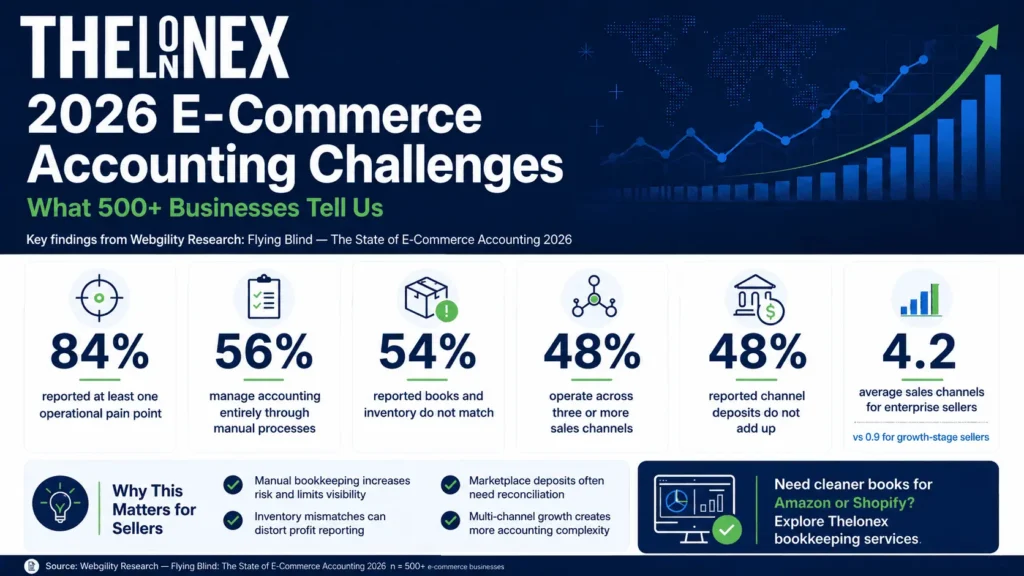
Key Findings From the 2026 E-Commerce Accounting Research
The research highlights several figures that demonstrate the scale of the accounting challenge:
| Accounting Challenge | Research Finding | Why It Matters |
|---|---|---|
| Operational pain | 84% reported at least one operational pain point | Accounting and operational problems are widespread rather than isolated. |
| Manual accounting | 56% manage their books entirely through manual processes | Manual processes increase workload as transaction volume and channel complexity grow. |
| Inventory reconciliation | 54% reported that books and inventory do not match | Inventory discrepancies can make COGS and profitability reporting less reliable. |
| Channel reconciliation | 48% reported channel deposits that do not add up | Marketplace payouts may not reconcile cleanly with sales and accounting records. |
| Multi-channel selling | 48% operate across three or more sales channels | Every additional channel introduces another payout cycle, fee structure and data source. |
| Enterprise complexity | Enterprise sellers average approximately 4.2 sales channels | Accounting complexity tends to increase as businesses expand across channels. |
Source: Webgility Research, Flying Blind: The State of E-Commerce Accounting 2026.
The E-Commerce Accounting Gap Is Growing
E-commerce growth does not simply produce more transactions. It produces more types of transactions.
A traditional business might receive a customer payment, record a sale and reconcile the corresponding bank deposit.
An Amazon or Shopify transaction can involve several additional layers.
A single sale may eventually create:
- marketplace or payment-processing fees;
- refunds or returns;
- shipping income and costs;
- discounts;
- sales-tax liabilities;
- fulfillment fees;
- inventory movements;
- cost of goods sold;
- reimbursements or marketplace adjustments.
When businesses add a second, third or fourth sales channel, those processes multiply.
The 2026 research found that 64% of businesses studied were already selling through at least two channels, while 48% operated three or more.
That means multi-channel accounting is increasingly a normal part of e-commerce rather than an accounting problem reserved for very large businesses.
1. Books and Inventory Don’t Match for Many E-Commerce Businesses
One of the most significant findings is that 54% of the businesses studied reported problems keeping their books and inventory synchronized.
For a product-based business, this matters because inventory has a direct relationship with cost of goods sold and gross profit.
Imagine an Amazon seller whose accounting system says $90,000 of inventory remains while the actual marketplace and warehouse data indicate a substantially different amount.
The problem does not stop at the balance sheet.
If inventory is inaccurate, cost of goods sold can also be inaccurate. Once COGS is wrong, gross margin and net profit can become unreliable.
That creates a dangerous situation where a seller may be making decisions based on a profit-and-loss statement that does not reflect economic reality.
What sellers should do
Inventory reconciliation should become part of the month-end accounting process rather than something reviewed only at tax time.
Growing businesses should compare:
- accounting inventory balances;
- Amazon or Shopify inventory information;
- third-party logistics inventory;
- purchase records;
- returns;
- damaged or lost inventory;
- inventory adjustments.
The objective is not simply to make the accounting system balance. It is to make sure the financial statements accurately represent the products the business actually owns and sells.
2. Marketplace Deposits Don’t Always Equal Revenue
The research found that 48% of businesses reported that channel deposits did not add up.
This issue is particularly relevant for Amazon FBA sellers.
An Amazon bank deposit is generally a net settlement amount rather than a simple representation of gross sales.
The settlement may reflect sales as well as marketplace fees, refunds, reimbursements and other adjustments.
Recording the bank deposit as one revenue entry can therefore hide important information about where the seller’s money went.
Thelonex’s Amazon FBA bookkeeping process, for example, is designed to break settlements into their underlying components instead of treating a marketplace payout as a single sales figure.
Why reconciliation matters
Consider this simplified example:
A marketplace reports:
Gross sales: $50,000
Fees: $7,000
Refunds: $3,000
Other adjustments: $1,000
Net payout: $39,000
If the accounting system records only the $39,000 deposit as sales, both revenue and expenses can be misstated.
Proper settlement reconciliation records the economic activity behind the payout.
That provides a much clearer foundation for financial reporting.
3. Manual Bookkeeping Remains Common
Another major finding from the research is that 56% of e-commerce businesses manage their books entirely through manual processes.
Manual accounting may remain manageable when a store is small.
The problem appears when transaction volume, inventory and sales channels increase.
A spreadsheet that worked with one Shopify store and 50 monthly orders may become difficult to maintain when the business operates across Amazon, Shopify and additional marketplaces with hundreds or thousands of transactions.
Manual accounting can also create dependency on repetitive work such as:
- exporting marketplace reports;
- copying spreadsheet data;
- categorizing transactions;
- comparing payouts;
- entering journal entries;
- reconciling payment processors;
- tracking inventory adjustments.
Automation does not eliminate the need for professional review. It can, however, reduce repetitive data handling and make reconciliation workflows more scalable.
4. Multi-Channel Growth Creates an Accounting Multiplier
Selling through more channels can increase revenue opportunities, but it also creates more accounting surfaces.
According to the Webgility research, 48% of active e-commerce sellers studied operated three or more channels.
Enterprise-level businesses averaged approximately 4.2 channels.
Every channel can introduce a different:
- settlement schedule;
- transaction format;
- fee structure;
- refund process;
- payment processor;
- sales-tax treatment;
- inventory feed;
- reconciliation workflow.
That is why accounting complexity can grow faster than order volume alone suggests.
A business selling $500,000 through one storefront may have a simpler accounting structure than a similarly sized business dividing those sales between Amazon, Shopify, Walmart and a wholesale channel.
What These Findings Mean for Amazon FBA Sellers
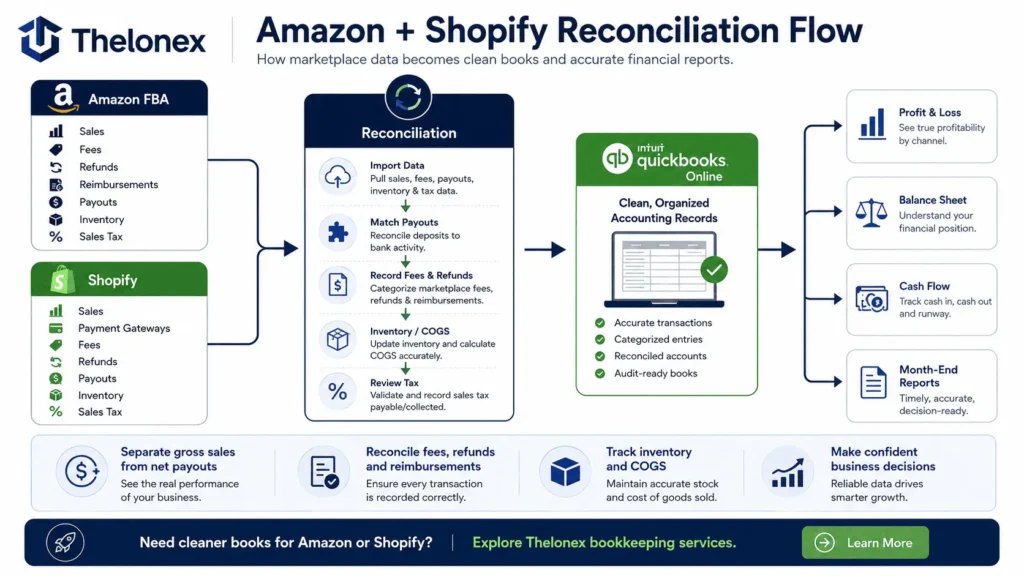
Amazon FBA bookkeeping becomes complicated because financial activity is distributed across Seller Central, settlement reports, bank accounts, inventory records and accounting software.
A seller should be able to answer questions such as:
How much did we actually sell?
How much did Amazon deduct in fees?
How much was refunded?
Were reimbursements recorded properly?
What is our accurate COGS?
Does the settlement reconcile with the bank?
What was our real profit after marketplace expenses?
When settlement data is not properly mapped into an accounting system such as QuickBooks Online, answering those questions becomes harder.
For sellers experiencing this issue, Thelonex has a dedicated Amazon FBA Bookkeeping service
What These Findings Mean for Shopify Sellers
Shopify bookkeeping has a different set of reconciliation challenges.
A growing store may receive money through:
- Shopify Payments;
- PayPal;
- Shop Pay;
- installment payments;
- gift cards;
- additional payment gateways.
The amount deposited into the bank account can therefore differ from the gross sales number shown elsewhere in Shopify.
Refunds, discounts, payment-processing costs and sales tax also need to be categorized properly.
Thelonex’s Shopify bookkeeping workflow reconciles Shopify payout activity into QuickBooks Online so the seller receives one consistent financial picture rather than disconnected numbers from the store, gateways and bank.
Shopify Bookkeeping service
Seven Ways E-Commerce Sellers Can Strengthen Their Accounting
The research identifies the problems. The next step is building systems that reduce them.
1. Use an accounting system designed for ongoing financial reporting
Spreadsheets may assist with analysis, but they should not become the only financial system for a growing multi-channel business.
QuickBooks Online can provide a central general ledger where bank activity, marketplace transactions, liabilities, expenses and financial statements can be reviewed consistently.
Thelonex currently configures QuickBooks Online specifically for Amazon and Shopify businesses, including chart-of-accounts structure and e-commerce integrations.
2. Reconcile marketplace settlements instead of recording net deposits as revenue
A bank deposit shows how much cash arrived.
It does not necessarily explain the financial activity that produced that cash.
Reconcile Amazon settlements and Shopify payouts against their underlying sales, fees, refunds and adjustments.
3. Reconcile inventory and COGS every month
Inventory should not be treated as an annual tax-season adjustment.
Growing product businesses need a repeatable monthly process for identifying inventory discrepancies and keeping cost of goods sold reasonably accurate.
4. Connect sales channels to accounting using appropriate integrations
Tools such as A2X can help summarize and map marketplace financial activity into accounting software.
However, the integration still needs to be configured correctly.
Account mapping, clearing accounts, payment gateways and tax treatment should be reviewed rather than assuming that connecting software automatically guarantees accurate books.
For a deeper comparison, link this section internally to Thelonex’s A2X content:
5. Create a formal month-end close process
A reliable month-end process should typically address:
- bank reconciliation;
- credit-card reconciliation;
- Amazon settlement reconciliation;
- Shopify payout reconciliation;
- inventory;
- COGS;
- payment gateways;
- accounts payable;
- sales-tax liabilities;
- unusual transactions;
- P&L review;
- balance-sheet review.
Thelonex states that its monthly bookkeeping service delivers P&L, balance-sheet and reconciliation reporting by the fifth working day as part of its ongoing bookkeeping model.
6. Fix historical bookkeeping before adding more automation
Automating inaccurate opening balances or poorly structured accounts does not solve the underlying problem.
If a business is already several months behind, it can be more effective to clean up the historical books first and then establish a recurring month-end process.
Thelonex’s catch-up bookkeeping service is available
7. Review financial information as a decision-making tool
Bookkeeping should answer business questions.
The goal is not simply to produce reports for tax season.
Accurate financial information should help an owner understand:
- gross margin;
- true net profit;
- advertising affordability;
- inventory purchasing capacity;
- cash position;
- operating expenses;
- marketplace fee trends;
- tax liabilities;
- whether the business can afford to expand.
Practical Accounting Action Plan by Business Stage
| Business Stage | Typical Accounting Risk | Recommended Priority |
|---|---|---|
| Early-stage seller | DIY bookkeeping and inconsistent categorization | Set up QuickBooks correctly and create a monthly reconciliation routine. |
| Growing single-channel seller | Increasing payout, fee and inventory complexity | Automate marketplace data where appropriate and reconcile settlements monthly. |
| Multi-channel seller | Disconnected Amazon, Shopify and payment data | Create one consolidated accounting workflow and central general ledger. |
| High-volume seller | Inventory, COGS, tax and month-end close complexity | Implement formal close procedures, inventory reconciliation and management reporting. |
| Seller with overdue books | Historical errors compound as new transactions arrive | Complete catch-up bookkeeping before relying on ongoing automation and reporting. |
Why Accurate E-Commerce Books Matter Beyond Tax Season
The biggest consequence of poor bookkeeping is not necessarily the bookkeeping itself.
It is uncertainty.
If an owner cannot trust inventory, sales, fees or cash balances, important operating decisions become more difficult.
Consider an Amazon seller deciding whether to place a $60,000 inventory order.
The seller needs to know whether enough cash exists after:
- outstanding expenses;
- advertising;
- taxes;
- supplier payments;
- upcoming marketplace deductions.
Or consider a Shopify business deciding whether to increase paid advertising by $15,000 per month.
Revenue alone cannot answer whether that decision makes sense.
Management needs accurate gross margin, operating expenses and cash-flow information.
Reliable bookkeeping therefore functions as part of the business’s decision-making infrastructure.
About the 2026 Research
The statistics discussed in this article come from Webgility’s Flying Blind: The State of E-Commerce Accounting 2026 research.
This distinction is important:
The study was not a consumer survey.
Webgility states that the research was developed from more than two years of real conversations with over 500 e-commerce businesses.
The 2023–2026 cohort included businesses operating across Shopify, Amazon, eBay, Etsy, Walmart, POS and other channels.
According to Webgility, company information was anonymized and businesses were classified based on operational evidence such as channel count, inventory complexity and operational structure rather than simply revenue or self-selected business categories.
Because the research reflects Webgility’s own discovery-conversation dataset, the results should be interpreted as findings from the businesses included in that dataset rather than a census of the entire e-commerce industry.
Original research source:
Webgility Research — Flying Blind: The State of E-Commerce Accounting 2026
How Thelonex Helps Amazon and Shopify Sellers
Thelonex specializes in bookkeeping for Amazon FBA and Shopify businesses operating in the United States and Canada.
Its services include:
- monthly QuickBooks bookkeeping;
- Amazon FBA settlement reconciliation;
- Shopify payout reconciliation;
- QuickBooks Online setup;
- A2X setup and mapping;
- catch-up bookkeeping;
- inventory reconciliation;
- financial reporting;
- U.S. and Canadian sales-tax support.
The company’s current plans begin at $199 per month, with additional plans for businesses with higher order volumes, inventory complexity and multi-channel requirements.
Ready to Build a More Reliable E-Commerce Accounting System?
If your Amazon settlements do not match your books, your Shopify payouts are difficult to reconcile, your inventory numbers keep changing or your financial reporting is several months behind, fixing the accounting process becomes more important as the business grows.
Thelonex works specifically with Amazon FBA and Shopify sellers to build clean QuickBooks records, reconcile marketplace activity and produce consistent monthly financial reporting.
By:

Ashfaq helps e-commerce business owners turn messy numbers into clear, reliable financials. With over 15 years of experience, he specializes in bookkeeping for Amazon and Shopify sellers, ensuring accuracy, clarity, and confident decision-making.
E-COMMERCE ACCOUNTING FAQ
Frequently Asked Questions
Get answers to common questions about Amazon FBA bookkeeping, Shopify reconciliation, inventory, QuickBooks, and e-commerce accounting.
What are the biggest e-commerce accounting challenges in 2026?
Common e-commerce accounting challenges include keeping inventory and accounting records synchronized, reconciling marketplace payouts, managing bookkeeping manually, tracking multiple sales channels, recording marketplace fees and refunds, handling sales tax, and maintaining accurate profit reporting.
Research involving more than 500 e-commerce businesses found that operational and accounting pain points remain common as businesses grow across Amazon, Shopify, and other sales channels.
Why is Amazon FBA bookkeeping complicated?
Amazon FBA bookkeeping is more complex than simply recording the amount deposited into your bank account. Amazon settlement reports can contain gross sales, FBA fees, marketplace fees, refunds, reimbursements, reserves, inventory adjustments, and other transactions.
These components should be categorized and reconciled correctly so your QuickBooks records show accurate revenue, expenses, inventory, and profitability.
Learn more about Amazon FBA bookkeeping →Why can Shopify payouts be different from Shopify sales?
Shopify sales and bank deposits can differ because payouts may be affected by payment-processing fees, refunds, discounts, taxes, chargebacks, timing differences, and transactions processed through different payment gateways.
A Shopify store may also receive payments through Shopify Payments, PayPal, Shop Pay, and other providers. Each payment stream should be reconciled correctly before the books are considered complete.
Learn more about Shopify bookkeeping →Why do e-commerce books and inventory stop matching?
Books and inventory can become inconsistent because of unrecorded inventory movements, returns, damaged or lost products, incorrect cost-of-goods-sold entries, marketplace adjustments, timing differences, purchase-record errors, or disconnected accounting and inventory systems.
Regular inventory reconciliation helps ensure that inventory, cost of goods sold, gross margin, and financial reports remain reliable.
Is manual bookkeeping suitable for an e-commerce business?
Manual bookkeeping may be manageable for a very small store with limited transactions. However, it becomes increasingly difficult as order volume, payment gateways, inventory, marketplaces, and sales channels increase.
Growing e-commerce businesses generally benefit from a structured accounting system such as QuickBooks Online, appropriate marketplace integrations, and a consistent reconciliation process.
How often should Amazon and Shopify sellers reconcile their books?
Amazon and Shopify businesses should normally complete a formal reconciliation as part of their monthly bookkeeping process. High-volume businesses may monitor marketplace settlements, payment gateways, and bank accounts more frequently.
A month-end close should typically include bank reconciliation, marketplace payout reconciliation, payment processors, inventory, cost of goods sold, sales-tax liabilities, and financial-statement review.
What accounting software is commonly used for Amazon and Shopify bookkeeping?
QuickBooks Online is commonly used as the main accounting ledger for Amazon and Shopify businesses. E-commerce accounting tools such as A2X can also help summarize marketplace transactions and send accounting entries into QuickBooks.
Connecting software does not automatically guarantee accurate books. Account mappings, clearing accounts, taxes, refunds, inventory, and payout reconciliation still need to be configured and reviewed correctly.
Learn more about QuickBooks setup →What should I do if my e-commerce books are several months behind?
Start by identifying how many months need to be corrected and collecting the relevant bank statements, credit-card statements, Amazon or Shopify reports, payment-processor records, inventory information, and previous accounting records.
Historical transactions should then be categorized and reconciled before establishing a recurring monthly bookkeeping process. Automating inaccurate historical records can make the problem harder to correct later.
Learn more about catch-up bookkeeping →Still have questions about your e-commerce books?
Speak with Thelonex about Amazon FBA, Shopify, reconciliation, QuickBooks, or catch-up bookkeeping.
Tags:
Categories
Latest Posts
- August 2, 2026
Amazon Seller Connector by QuickBooks: Complete Guide
- July 21, 2026
How COGS Accounting Works for Canadian FBA Sellers
Tags
A2X
Accounting Method
Amazon FBA
Amazon Marketplace Connector
Amazon Seller Central
Amazon Seller Connector
Bookkeeping Tips
Canada Tax Registration
Canadian Bookkeeping
Canadian Sales Tax
Chart of Accounts
COGS
E-Commerce
E-Commerce Bookkeeping
Finance
Financial Statements
GST/HST
Inventory
Payout Reconciliation
Profit and Loss
QuickBooks Online
Sales Tax
Sales Tax Compliance
Shopify
TaxCloud