QuickBooks Bookkeeping for Amazon FBA & Shopify | Thelonex


How Catch-Up Bookkeeping Works for Canadians
- Home
- How Catch-Up Bookkeeping Works for Canadians
- July 21, 2026
- 5 min read
- No Comments

How Catch-Up Bookkeeping Works for Canadian Sellers
Months of unreconciled Amazon settlements and Shopify payouts do not fix themselves. Every month you wait adds more transactions to sort through, and the CRA does not pause filing deadlines while you catch up.
This guide explains how catch-up bookkeeping works for Canadian Amazon and Shopify sellers, so you know exactly what a proper reset looks like. It’s part of our complete Canadian bookkeeping guide — see our resources hub for more free tools and guides.
Quick takeaways • A three-month gap takes far less time to reconstruct than a two-year one — starting early costs less • Source documents come first: bank statements, settlement reports, and payout history, before anything gets entered • Your chart of accounts should be fixed before historical data is entered, not after • A fixed-price quote is usually possible once your source documents are gathered |
What Is Catch-Up Bookkeeping?
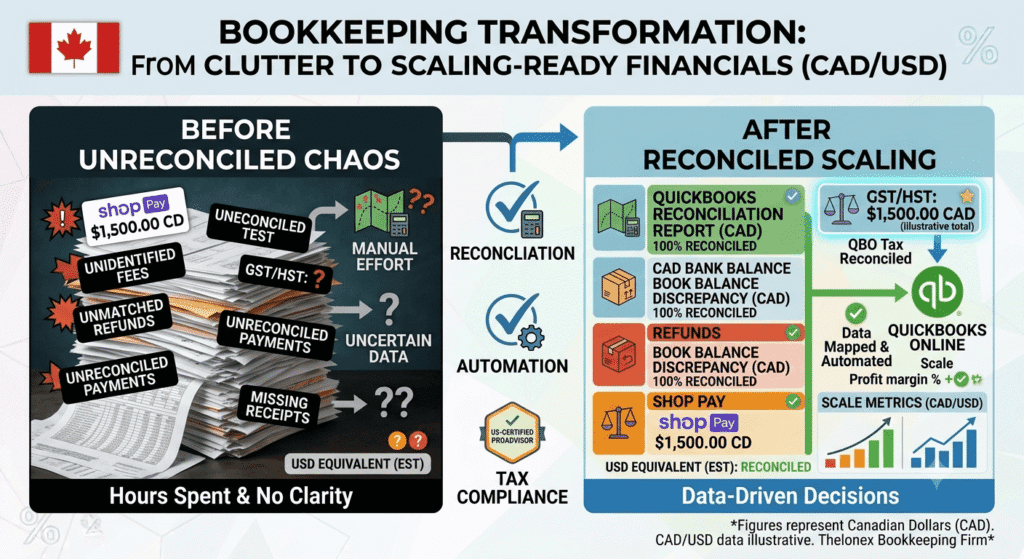
Catch-up bookkeeping is the process of reconstructing months or years of missed or incomplete financial records, then reconciling them into a clean, accurate QuickBooks file. It brings your books from wherever they currently stand up to the present month.This is for you if you have not reconciled your books in several months, inherited a messy QuickBooks file, or are behind on GST/HST filings and need accurate numbers before you can file.Why Catch-Up Bookkeeping Matters for Canadian Sellers
Falling behind on bookkeeping creates two problems that compound over time. The first is tax risk: if you are GST/HST registered, the CRA expects accurate filings on schedule, and estimated or missing numbers increase audit risk. The second is decision risk — without current books, you have no reliable way to know if your business is actually profitable.The mistake A seller stops reconciling for eight months while sales grow, with no accurate GST/HST return filed during that stretch. | The fix Records are reconstructed month by month from source documents, so every filing period has real numbers behind it before anything is submitted to the CRA. |
| Next step• If you’re not sure how far behind your books actually are, that’s the first thing worth finding out. Thelonex quotes catch-up projects at a fixed price before any work begins. Book a free consultation to get a clear answer. |
Step-by-Step Guide to Catch-Up Bookkeeping
Step 1: Gather Your Source Documents
Pull bank statements, Amazon settlement reports, Shopify payout history, and any existing QuickBooks data for the full period you need to catch up. Missing statements are the most common delay in this process.Step 2: Set Up or Correct Your Chart of Accounts
Before entering historical data, confirm your chart of accounts is built correctly, with separate accounts for revenue, fees, COGS, and GST/HST payable. Entering months of transactions into a flawed structure just moves the cleanup problem forward. See our QuickBooks setup guide for the correct structure.Step 3: Reconstruct Transactions Month by Month
Work through each month in order, connecting Amazon and Shopify data through A2X where possible, and manually reconciling any gaps A2X cannot fill, such as historical periods outside its data window.Step 4: Reconcile Every Account to Source Statements
Match every bank and credit card account to its actual statement balance for each month. This step confirms the reconstruction is accurate, not just complete.Step 5: Calculate Outstanding GST/HST Liability
Once transactions are reconciled, calculate what GST/HST you collected and what input tax credits you are owed for the catch-up period. This number is what you will need for any outstanding filings. See our guide on GST/HST for Amazon sellers in Canada for the filing rules.Step 6: File Outstanding Returns and Move to Monthly Bookkeeping
With accurate historical numbers in hand, file any outstanding GST/HST returns, then transition to a monthly reconciliation schedule so you do not end up back in the same position.Practical Tips for Better Results
need current numbers quickly for an urgent filing or decision, then continue reconstructing older months afterward.- Do not estimate figures instead of pulling them from actual settlement and bank data
- Do not skip the chart of accounts review before entering historical transactions
- Do not file GST/HST returns based on unreconciled numbers just to meet a deadline
- Do not treat catch-up as a one-time fix without setting up ongoing monthly bookkeeping afterward
Conclusion
Catch-up bookkeeping for Canadian sellers is a defined process: gather records, fix the chart of accounts, reconstruct transactions month by month, and reconcile everything to source statements before filing anything with the CRA. The sooner you start, the smaller the project.Next step Thelonex handles catch-up bookkeeping for Canadian Amazon and Shopify sellers at a fixed price, quoted before work begins, with the same QuickBooks Online ProAdvisor certified standard as our monthly plans. To find out how far behind you actually are, and what it takes to fix it. Book a Free Consultation |
By:

Ashfaq helps e-commerce business owners turn messy numbers into clear, reliable financials. With over 15 years of experience, he specializes in bookkeeping for Amazon and Shopify sellers, ensuring accuracy, clarity, and confident decision-making.
Categories
Latest Posts
- August 2, 2026
Amazon Seller Connector by QuickBooks: Complete Guide
- July 21, 2026
How COGS Accounting Works for Canadian FBA Sellers
Tags
A2X
Accounting Method
Amazon FBA
Amazon Marketplace Connector
Amazon Seller Central
Amazon Seller Connector
Bookkeeping Tips
Canada Tax Registration
Canadian Bookkeeping
Canadian Sales Tax
Chart of Accounts
COGS
E-Commerce
E-Commerce Bookkeeping
Finance
Financial Statements
GST/HST
Inventory
Payout Reconciliation
Profit and Loss
QuickBooks Online
Sales Tax
Sales Tax Compliance
Shopify
TaxCloud