QuickBooks Bookkeeping for Amazon FBA & Shopify | Thelonex


Amazon FBA Canada for US Sellers: Full Guide
- Home
- Amazon FBA Canada for US Sellers: Full Guide
- June 6, 2026
- 9 min read
- No Comments
Amazon FBA Canada for US Sellers: The Complete Launch Guide
Selling on Amazon FBA Canada is one of the fastest ways a US brand can grow beyond its home market. The country sits next door, shares your consumer culture, and actively imports US products.
But the path from your US seller account to a fully compliant Canadian FBA operation involves tax registrations, customs bonds, and import rules that most sellers have never encountered.
This guide walks you through every phase, from registering with the Canada Revenue Agency to claiming your border tax refunds, so you can launch with confidence and protect your margins from day one.
What Is Amazon FBA Canada for US Sellers?
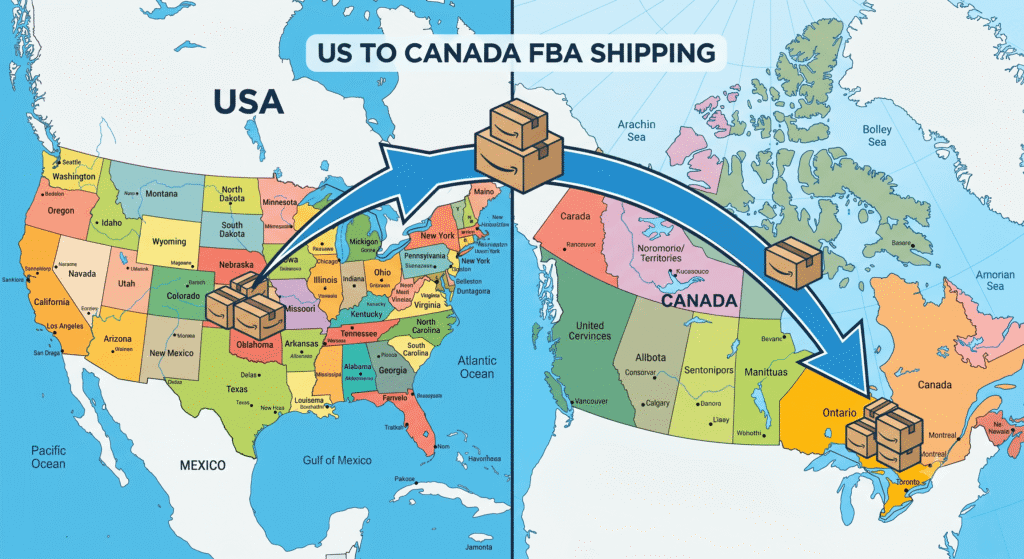
Amazon FBA Canada (Fulfillment by Amazon) lets you store your inventory inside Canadian Amazon warehouses. Amazon then picks, packs, and ships each order to Canadian customers on your behalf.
For a US seller, this means shipping your products across the border into Canada, where they become subject to Canadian import and tax rules. Amazon handles last-mile delivery and customer service. You handle compliance.
This model is designed for US-based eCommerce brands, Amazon sellers scaling internationally, and Shopify sellers looking to diversify into a new market. If you already sell on Amazon.com, the learning curve is shorter than you think.
Why Amazon FBA Canada Matters for US Sellers
Canada is the most accessible international market for US eCommerce businesses. Consumers speak English, trust American brands, and spend heavily online. Amazon.ca is one of the country’s top retail destinations.
Here is what makes the expansion worthwhile:
- Immediate revenue growth. You tap into tens of millions of new shoppers without building a new brand from scratch.
- Shared consumer profile. Canadian buyers respond well to US brands and are familiar with Amazon Prime delivery expectations.
- Recoverable border tax. The 5% import GST paid at the border is fully refundable once you hold the right registration.
- Simplified provincial taxes. Amazon automatically collects and remits provincial sales taxes (PST, QST, RST) under Canada’s Marketplace Facilitator Laws. You handle one federal account, not five provincial ones.
- Treaty-based corporate protection. The Canada-US Tax Treaty shields your US profits from Canadian income tax, provided you maintain a clean non-resident footprint.
The risk of skipping compliance is significant. Frozen inventory at the border, retroactive tax assessments, and suspended seller accounts are the real costs of cutting corners. Setting up correctly on day one costs far less than cleaning up a compliance failure later.
“Amazon handles provincial tax collection at checkout — but your federal GST/HST registration, quarterly filings, and CRA compliance still require expert management. See how our Canadian GST/HST registration and filing services cover every obligation.”
Step-by-Step Guide to Launching on Amazon FBA Canada
Follow these five phases in order. Each phase builds on the previous one. Skipping steps creates gaps that can delay shipments or trigger tax penalties.
Step 1: Register Your US Entity with the Canada Revenue Agency (CRA)
Before any inventory moves, the CRA must recognize your US business. This is your corporate tax footprint in Canada.
You will need to:
- Submit your US entity details (state formation records, IRS documentation) to the CRA.
- Receive a 9-digit Business Number (BN), which acts as your master corporate tax ID in Canada.
- Activate a Standard GST/HST account (RT 0001 suffix). This is the account that unlocks your import tax refunds.
Critical detail: Your legal entity name on your IRS documentation must match character-for-character on your CRA application. A single discrepancy causes an immediate rejection.
Step 2: Set Up Your Customs and Importation Profile
A GST/HST account lets you collect and remit tax. It does not give you the legal authority to move physical goods across the Canadian border. For that, you need a separate import program account.
This step involves two actions:
- Activate an Import/Export program account (RM 0001 suffix) tied to your Business Number. This designates your US company as the legal Importer of Record (IOR) for Canadian customs.
- Register on the CBSA CARM Portal (CBSA Assessment and Revenue Management), the Canadian Border Services Agency’s mandatory digital clearance system. You also grant power of attorney to a licensed Canadian Customs Broker here.
Your customs broker will use your RM 0001 number to clear every inbound shipment. Without this account active, freight cannot be released at the border.
Step 3: Secure Your Customs Surety Bond
Canadian regulations require non-resident importers to post a financial guarantee before goods can cross the border. This is your Customs Surety Bond.
The bond activates the Release Prior to Payment program, which allows your freight to clear customs immediately while duty and tax processing happens separately. Without it, shipments wait at the border until every fee is settled, which can mean days of delay and additional warehouse costs.
Estimated annual cost: approximately $250 USD.
Step 4: Ship Inventory and Sync with Amazon Seller Central
With your tax account, import profile, and customs bond in place, you are ready to move inventory.
Here is the logistics chain:
- Your freight forwarder transports pallets from the US to the Canadian border.
- Your customs broker clears the cargo using your RM 0001 account number.
- Inventory is routed to the designated Amazon Canada fulfillment center.
- You input your active 9-digit GST/HST number directly into Amazon Seller Central. Amazon then takes over marketplace tax collection at checkout for every Canadian sale.
Step 5: Manage Ongoing Tax Filing and Corporate Compliance
Once live, your US business has recurring legal obligations in Canada. These are not optional. Missing filings leads to penalties, and failing to file refund claims leaves real money uncollected.
Two recurring obligations apply:
- Quarterly GST/HST Returns. You file these quarterly to report your gross Canadian sales. More importantly, you use them to claim a cash refund on the 5% import GST paid at the border. Each filing triggers a direct refund from the CRA back to your US company.
- Annual Treaty-Based Corporate Tax Return (T2 with Schedule 91). Storing physical stock in Canada creates a Canadian corporate filing requirement. However, by filing Schedule 91 under the Canada-US Tax Treaty, you formally declare that your business has no Canadian office, staff, or permanent establishment on Canadian soil. This results in zero Canadian income tax owed while keeping you compliant and avoiding steep non-filing penalties.
- “Clean quarterly filings depend on clean books. Our monthly QuickBooks bookkeeping for Amazon FBA sellers ensures your Canadian revenue, COGS, and payout data are reconciled and ready for every CRA filing.”
Practical Tips for a Smooth Amazon FBA Canada Launch
Actionable Advice
- Start the CRA registration 4 to 6 weeks before your first shipment. Government processing takes time. Starting early means your account is active before inventory needs to move.
- Use a licensed Canadian Customs Broker from day one. A broker who knows non-resident importer rules will prevent clearance errors and ensure your RM 0001 number is used correctly on every shipment.
- Keep your CRA account in Standard mode. A Simplified GST/HST account does not allow you to reclaim import GST. Make sure your registration is Standard from the start.
- Track all import receipts. The 5% GST paid at the border is only refundable when you have the supporting customs documentation. File it, do not lose it.
- Do not skip the T2/Schedule 91 return. Many US sellers assume this does not apply to them. It does. The good news is that filing correctly costs you nothing in Canadian income tax. Not filing can cost thousands in penalties.
Common Mistakes to Avoid
- Opening a Simplified instead of Standard GST/HST account. This is the single most costly administrative error. It blocks all import tax refunds. “Getting the account type wrong is one of the most expensive and avoidable errors US sellers make. Our GST/HST compliance for Amazon sellers includes registration review so you start with the right setup.”
- Entering Canada without an RM 0001 account. Your inventory will be held at the border until you establish a legal Importer of Record identity.
- Mismatched entity names on CRA filings. Even a single character difference between your IRS name and your CRA application causes rejection.
- Treating import GST as a sunk cost. If you never file to reclaim it, the government keeps money that legally belongs to your business.
- Opening a Canadian business bank account unnecessarily. This changes your non-resident status and increases your compliance complexity and cost significantly.
Efficiency Tips for Managing Registrations
- Bundle all Phase 1 and Phase 2 registrations with the same cross-border accountant or compliance firm. Doing them sequentially with different providers creates delays and coordination gaps.
- Set quarterly filing reminders in your calendar on the first day your GST account is activated. The CRA assigns filing deadlines based on your registration date, not your first sale.
- Store all customs clearance documents in one organized folder. Your customs broker will send entry packages after each shipment. These are the source documents for your quarterly GST refund claims.
Conclusion
Launching on Amazon FBA Canada is a proven growth strategy for US sellers who want to reach a new market without reinventing their brand.
The compliance framework is not optional, but it is manageable. Register your Business Number with the CRA. Activate your Standard GST/HST and import accounts. Secure your customs bond. Ship your inventory. File quarterly to recover your border tax. File annually to maintain treaty protection.
Each phase has a clear purpose, and together they build a foundation that protects your margins and keeps your supply chain running without interruption.
This guide will continue to attract US sellers researching their Canada expansion for years to come. Every seller who finds it is a potential client looking for exactly the compliance expertise described here.

Ashfaq helps e-commerce business owners turn messy numbers into clear, reliable financials. With over 15 years of experience, he specializes in bookkeeping for Amazon and Shopify sellers, ensuring accuracy, clarity, and confident decision-making.
Ready to build your Canadian expansion the right way?
Contact our cross-border accounting team today to schedule your complimentary business assessment. We handle the registrations, and quarterly filings so you can focus on growing your brand.
Categories
Latest Posts
- August 2, 2026
Amazon Seller Connector by QuickBooks: Complete Guide
- July 21, 2026
How COGS Accounting Works for Canadian FBA Sellers
Tags
A2X
Accounting Method
Amazon FBA
Amazon Marketplace Connector
Amazon Seller Central
Amazon Seller Connector
Bookkeeping Tips
Canada Tax Registration
Canadian Bookkeeping
Canadian Sales Tax
Chart of Accounts
COGS
E-Commerce
E-Commerce Bookkeeping
Finance
Financial Statements
GST/HST
Inventory
Payout Reconciliation
Profit and Loss
QuickBooks Online
Sales Tax
Sales Tax Compliance
Shopify
TaxCloud