QuickBooks Bookkeeping for Amazon FBA & Shopify | Thelonex


Bookkeeping for Canadian Amazon & Shopify Sellers
- Home
- Bookkeeping for Canadian Amazon & Shopify Sellers
- July 21, 2026
- 8 min read
- No Comments

Bookkeeping for Canadian Amazon & Shopify Sellers
You didn’t start selling on Amazon or Shopify to become a bookkeeper. You started because you had a product worth selling. But running a Canadian ecommerce business means your books have to handle something most bookkeeping guides ignore completely.
Your revenue sits in CAD, or sometimes USD. Your tax rules follow the Canada Revenue Agency, not the IRS. And every Amazon or Shopify deposit hides more than it shows. Most bookkeeping content is written for US sellers, with Canada bolted on as an afterthought. That gap costs Canadian sellers real money: missed input tax credits, messy multi-currency reports, and books that fall apart the moment tax season starts.
This guide fixes that, and it’s one of several free, Canada-specific guides in our resources hub. You will learn what bookkeeping actually involves for Canadian Amazon and Shopify sellers, why it matters for your bottom line, and the exact steps to set up QuickBooks correctly. You will also see where GST/HST fits into your books, and where to go for the full tax rules.
Quick takeaways • Amazon and Shopify deposits are net numbers — your real revenue, fees, and GST/HST are hidden inside them • GST/HST payable needs its own QuickBooks account, kept separate from sales revenue • Multi-currency has to be configured correctly from your very first transaction • Clean monthly books mean faster tax filing and profit numbers you can actually trust |
What Is Bookkeeping for Canadian Amazon & Shopify Sellers?
Bookkeeping is the process of recording, organizing, and reconciling every transaction in your business. For Canadian Amazon and Shopify sellers, that means matching your Amazon settlement reports and Shopify payouts to your bank account inside QuickBooks Online.It covers four things: revenue, cost of goods sold, platform fees, and tax. Done right, your books show real profit per product. Done wrong, they show a single lump deposit and nothing else.This applies to you if you run a Canadian-registered business selling on Amazon.ca or Amazon.com. It also applies if you run a Shopify store shipping from or into Canada, or if you have crossed the GST/HST registration threshold. If you sell in both CAD and USD, this applies to you too.Why Bookkeeping Matters for Canadian Sellers
Clean books protect your business in three ways. First, they show your true profit — Amazon and Shopify deposits are net numbers that hide fees, refunds, and shipping costs inside one transfer. Second, they make tax season simple, because the CRA expects accurate records once you are GST/HST registered. Third, they help you grow: lenders, investors, and even Amazon’s own reserve systems look at your financial statements, and messy books signal risk.For Canadian sellers, there is a fourth reason: currency. If you sell in USD but bank in CAD, or the reverse, your books need to track exchange gains and losses correctly. Get this wrong, and your profit and loss statement will never match your bank balance. Here is what that gap looks like in practice.What it looks like $40,000 lands in your bank account for the month. It feels like a strong month for your Ontario Shopify store. | What’s actually true Once fees, refunds, shipping, GST/HST collected, and cost of goods sold are pulled out, real profit is closer to $9,000. |
How Canadian Bookkeeping Differs From US Bookkeeping
Most bookkeeping software, templates, and blog content are built for US sellers. Copy that approach into a Canadian business, and three gaps show up fast.Tax structure. US sellers deal with state sales tax and economic nexus. Canadian sellers deal with GST/HST, and in some provinces, PST or QST on top — different systems with different registration rules that a US-focused chart of accounts has no place for. Our Sales Tax Services page covers how we handle registration and filing across provinces.Currency. Many Canadian sellers list products in USD on Amazon.com while banking in CAD, or the reverse on Shopify. A US template assumes one currency. Your books need to track two, plus the exchange gain or loss between them.Reporting. Canadian lenders, accountants, and the CRA expect financial statements formatted to Canadian standards, with GST/HST clearly separated from revenue. A P&L built for a US audience often buries this detail or leaves it out.None of these gaps are hard to close. They just require a bookkeeping setup built for Canada from the start, not a US template adjusted after the fact.Step-by-Step Guide to Bookkeeping for Canadian Sellers
Step 1: Build a Chart of Accounts for Canadian Ecommerce
Start with a chart of accounts built for Amazon and Shopify, not a generic template. You need separate accounts for product revenue, shipping income, Amazon fees, Shopify fees, refunds, and cost of goods sold. See our full QuickBooks setup guide for the exact account list. Add GST/HST payable and GST/HST recoverable as their own liability accounts, kept apart from revenue. Mixing tax with sales income is the most common mistake Canadian sellers make.Step 2: Connect Amazon and Shopify Through A2X
Manual data entry does not scale past a handful of orders. Connect your Amazon Seller Central and Shopify accounts to A2X. A2X breaks every settlement or payout into fees, refunds, tax, and net sales, then posts it to QuickBooks automatically — preventing the biggest error in ecommerce bookkeeping: recording a bank deposit as a single line of revenue.Step 3: Reconcile Every Payout Monthly
Match every Amazon settlement and Shopify payout to your bank deposits each month. Our guides to Amazon FBA reconciliation and Shopify payout reconciliation walk through this in detail. Set a fixed monthly deadline, such as the 5th business day — waiting until year-end to reconcile twelve months of transactions is how most catch-up bookkeeping projects start.Step 4: Track GST/HST Separately From Sales
Once you are GST/HST registered, every taxable sale includes tax collected on behalf of the CRA. That tax is not your revenue — post it to a GST/HST payable account, never to your sales account. Do the same with input tax credits on business purchases.Step 5: Handle Multi-Currency Transactions Correctly
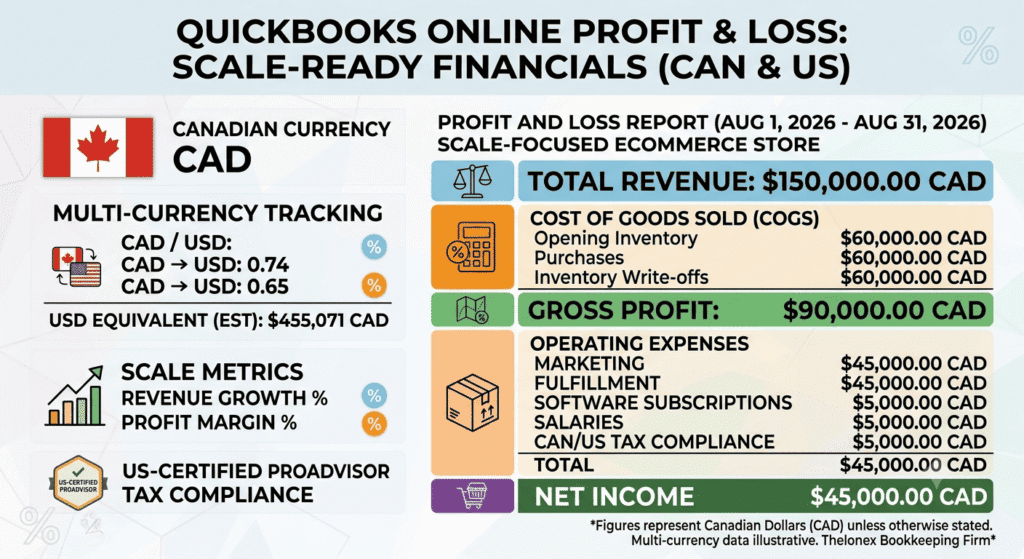
If you sell in USD and operate in CAD, turn on QuickBooks Online’s multi-currency feature. Set your home currency once and leave it alone. Record each transaction in its original currency and let QuickBooks calculate the exchange rate, and review your exchange gain or loss account every month.Step 6: Review Your Financial Statements Monthly
Look at your profit and loss statement and balance sheet every month, not just at tax time. Check gross margin by product line, using accurate cost of goods sold tracking, and compare it to the previous month. Small problems are easy to fix. Year-old problems are not.Practical Tips for Better Results
A few habits separate sellers with clean books from sellers who dread tax season.- Automate what you can — connect A2X, your bank feed, and your payment gateways so most transactions post themselves
- Track your GST/HST registration threshold monthly, not once a year, since the CRA reviews revenue on a rolling four-quarter basis
- Keep personal and business finances in separate bank accounts — the fastest way to make your books audit-ready
- Batch reconciliation and tax review into the same day each month instead of spreading tasks across random days
Where GST/HST Fits Into Your Books
GST/HST is a tax topic on its own, with rules that shift by province and revenue level. Your books need to record it correctly, but the registration and filing rules deserve a full guide of their own. For the complete breakdown of thresholds, provincial rates, and filing steps, see our guides on GST/HST for Shopify sellers in Canada and GST/HST for Amazon sellers in Canada.Conclusion: Get Your Canadian Books Right, Once
Bookkeeping for Canadian Amazon and Shopify sellers is not the same job as US ecommerce bookkeeping. It needs a Canadian-ready chart of accounts, correct GST/HST tracking, and multi-currency handling done right from day one. Get this foundation right once, and it keeps paying off every month after.Next step • Thelonex is a QuickBooks Online ProAdvisor certified bookkeeping firm built exclusively for Amazon FBA and Shopify sellers in the US and Canada. You get a dedicated account manager, monthly P&L and reconciliation reports delivered by the 5th business day, and GST/HST tracking built into every plan — starting at $199/month, 30 to 50% less than comparable US firms for the same certified standard. and see what your books could look like next month. Book a Free Consultation |
By:

Ashfaq helps e-commerce business owners turn messy numbers into clear, reliable financials. With over 15 years of experience, he specializes in bookkeeping for Amazon and Shopify sellers, ensuring accuracy, clarity, and confident decision-making.
Tags:
Categories
Latest Posts
- August 2, 2026
Amazon Seller Connector by QuickBooks: Complete Guide
- July 21, 2026
How COGS Accounting Works for Canadian FBA Sellers
Tags
A2X
Accounting Method
Amazon FBA
Amazon Marketplace Connector
Amazon Seller Central
Amazon Seller Connector
Bookkeeping Tips
Canada Tax Registration
Canadian Bookkeeping
Canadian Sales Tax
Chart of Accounts
COGS
E-Commerce
E-Commerce Bookkeeping
Finance
Financial Statements
GST/HST
Inventory
Payout Reconciliation
Profit and Loss
QuickBooks Online
Sales Tax
Sales Tax Compliance
Shopify
TaxCloud