QuickBooks Bookkeeping for Amazon FBA & Shopify | Thelonex


Cash vs Accrual Accounting: Which Fits Your Store?
- Home
- Cash vs Accrual Accounting: Which Fits Your Store?
- July 20, 2026
- 6 min read
- No Comments

Cash vs Accrual Accounting: Which Fits Your Store?
Every Amazon or Shopify seller has to make one accounting decision that affects every report going forward: cash or accrual. Pick the wrong one, and your profit and loss statement can be misleading for months.
This guide compares both methods in plain terms, explains how each one handles inventory and marketplace payouts, and shows which one fits most growing e-commerce businesses. It builds on our full e-commerce bookkeeping guide, which covers the full setup process from chart of accounts to monthly review.
What Is Cash vs Accrual Accounting?
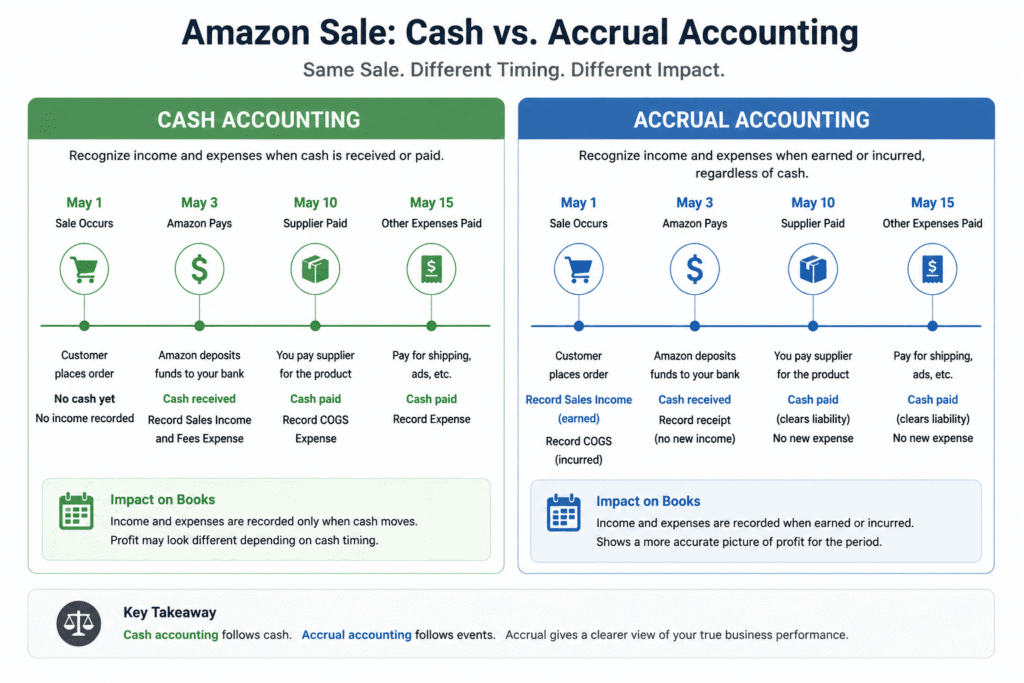
Cash and accrual are the two accounting methods used to decide when a transaction gets recorded in your books.
Cash accounting records income when money hits your bank account and expenses when money leaves it. It is simple and mirrors your actual cash flow.
Accrual accounting records income when a sale happens and expenses when they are incurred, regardless of when the cash moves. It matches revenue to the period it was earned.
Who This Decision Affects
This choice matters most for:
- Amazon FBA sellers with delayed settlement payouts
- Shopify sellers carrying physical inventory
- Sellers applying for loans, grants, or investment
- Any business required to file accrual-based tax returns above certain revenue thresholds in the US or Canada
A Quick Example
You make a sale on March 28. Amazon settles the payout on April 3. Under cash accounting, that sale is April income. Under accrual accounting, that sale is March income, because that is when it actually happened. If you are reviewing your March performance, only one of these methods gives you the right answer.
Why Choosing the Right Method Matters
Accrual accounting shows real profit timing. Amazon pays out every two weeks, not the day a sale happens. Under cash accounting, a sale made in one month might not show up as income until the next. Accrual accounting fixes that mismatch.
Cash accounting is easier to manage day to day. It requires less bookkeeping knowledge and reflects your actual bank balance, which appeals to very small or pre-revenue sellers.
Accrual accounting supports accurate inventory and COGS. Because e-commerce businesses hold inventory, accrual accounting is almost always required to properly match product cost to the sale that used it. Our guide on calculating COGS for e-commerce sellers explains this matching process in detail.
Tax authorities may require accrual accounting. In the US, businesses with average gross receipts above certain IRS thresholds, and those carrying inventory as a material income-producing factor, are generally required to use accrual accounting for tax purposes. Requirements vary, so confirm your specific obligation with a tax professional.
Accrual accounting makes month-over-month comparisons meaningful. Because revenue and costs are matched to the period they belong to, you can compare January to February and trust the difference reflects real business performance, not payout timing.
Step-by-Step Guide to Choosing Your Method
Step 1: Check If You Carry Inventory
If you hold physical inventory, accrual accounting is almost always the better fit, and may be required. Inventory needs to be tracked as an asset until it sells, which cash accounting cannot represent accurately.
Step 2: Review Your Revenue Level
As your revenue grows, tax rules in both the US and Canada increasingly favor or require accrual-based reporting. Confirm your specific threshold with a CPA, since rules change and vary by entity type.
Early-stage sellers under these thresholds still often benefit from switching early. Waiting until a threshold forces the change means restating an entire year of cash-basis records into accrual form, which is far more work than starting correctly.
Step 3: Consider Your Reporting Needs
If you need financials for a lender, investor, or potential buyer, accrual accounting is the standard they will expect. Cash-basis reports are harder to compare against industry benchmarks.
Step 4: Set Up Your Method in QuickBooks Online
QuickBooks Online lets you run reports on either basis, but your underlying transaction recording should match your chosen method consistently. Set this during your QuickBooks setup so every report going forward stays consistent.
Step 5: Apply the Method Consistently
Once you choose a method, apply it consistently across every transaction type, including sales, COGS, and expenses. Switching back and forth mid-year creates reporting gaps that are difficult to unwind later.
This includes how you record prepaid expenses, such as annual software subscriptions or prepaid inventory deposits. Under accrual accounting, these get spread across the periods they benefit, not expensed all at once on the day you pay.
Step 6: Review Your P&L Under the New Method
After switching, review your profit and loss statement carefully for the first full month. Confirm your numbers reflect the timing you expect before you rely on them for decisions. Our guide on reading your e-commerce P&L explains what each line should show.
Practical Tips for Better Results
Do not mix methods within QuickBooks. Running some reports cash-basis and others accrual-basis without labeling them clearly is one of the most common sources of confusion for sellers reviewing their own numbers.
Talk to a CPA before switching methods mid-year. Changing accounting methods can have tax filing implications. Confirm the timing and any required IRS or CRA filings before making the change.
Use accrual accounting if you are raising capital. Investors and lenders expect accrual-based financials as the standard. Starting on accrual early avoids a costly restatement later.
Watch your A2X posting settings. A2X can post settlement data in a way that aligns with either method, but the setting needs to match your chosen accounting method or your reports will not reconcile cleanly.
Do not confuse accounting method with bookkeeping quality. Choosing accrual accounting does not fix poor reconciliation habits. Both need to be right together. For a broader look at how accounting methods apply outside of e-commerce specifically, see our guide on choosing the right accounting method for your company.
A common mistake is starting on cash accounting because it feels simpler, then discovering months later that inventory and COGS numbers do not reflect real profit. Switching early costs far less than switching after a year of data has already been recorded incorrectly.
Keep your bank reconciliation on cash, your reporting on accrual. Your bank account will always run on cash in real life. The key is making sure your QuickBooks reports translate that into accrual-based numbers correctly, rather than trying to force your bank balance and P&L to match exactly.
Conclusion
Cash accounting is simple, but it rarely reflects true profit for an inventory-based e-commerce business. Accrual accounting takes more setup, but it matches revenue and expenses to when they actually happened, giving you numbers you can trust and act on.
Most growing Amazon FBA and Shopify sellers move to accrual accounting as soon as they carry meaningful inventory or plan to seek financing. Making the switch early, and setting it up correctly in QuickBooks Online, saves significant cleanup work later.
The right method is the one that shows you what actually happened in your business each month, not just what happened in your bank account.
Unsure which method fits your business right now? Book a free consultation and we will walk through your specific numbers with you.
By:

Ashfaq helps e-commerce business owners turn messy numbers into clear, reliable financials. With over 15 years of experience, he specializes in bookkeeping for Amazon and Shopify sellers, ensuring accuracy, clarity, and confident decision-making.
Categories
Latest Posts
- August 2, 2026
Amazon Seller Connector by QuickBooks: Complete Guide
- July 21, 2026
How COGS Accounting Works for Canadian FBA Sellers
Tags
A2X
Accounting Method
Amazon FBA
Amazon Marketplace Connector
Amazon Seller Central
Amazon Seller Connector
Bookkeeping Tips
Canada Tax Registration
Canadian Bookkeeping
Canadian Sales Tax
Chart of Accounts
COGS
E-Commerce
E-Commerce Bookkeeping
Finance
Financial Statements
GST/HST
Inventory
Payout Reconciliation
Profit and Loss
QuickBooks Online
Sales Tax
Sales Tax Compliance
Shopify
TaxCloud