QuickBooks Bookkeeping for Amazon FBA & Shopify | Thelonex


Bookkeeping vs Accounting: What’s the Difference?
- Home
- Bookkeeping vs Accounting: What’s the Difference?
- July 20, 2026
- 6 min read
- No Comments

Bookkeeping vs Accounting: What’s the Difference?
Most sellers use “bookkeeping” and “accounting” as if they mean the same thing. They do not, and confusing the two often means paying for the wrong service at the wrong time, or waiting too long to get help you actually need.
This guide explains the real difference between bookkeeping and accounting, what each one does for an Amazon or Shopify business, and how to know which one your business needs right now. It is part of our full e-commerce bookkeeping guide, which covers the entire financial process from setup to reporting.
What Is the Difference Between Bookkeeping and Accounting?
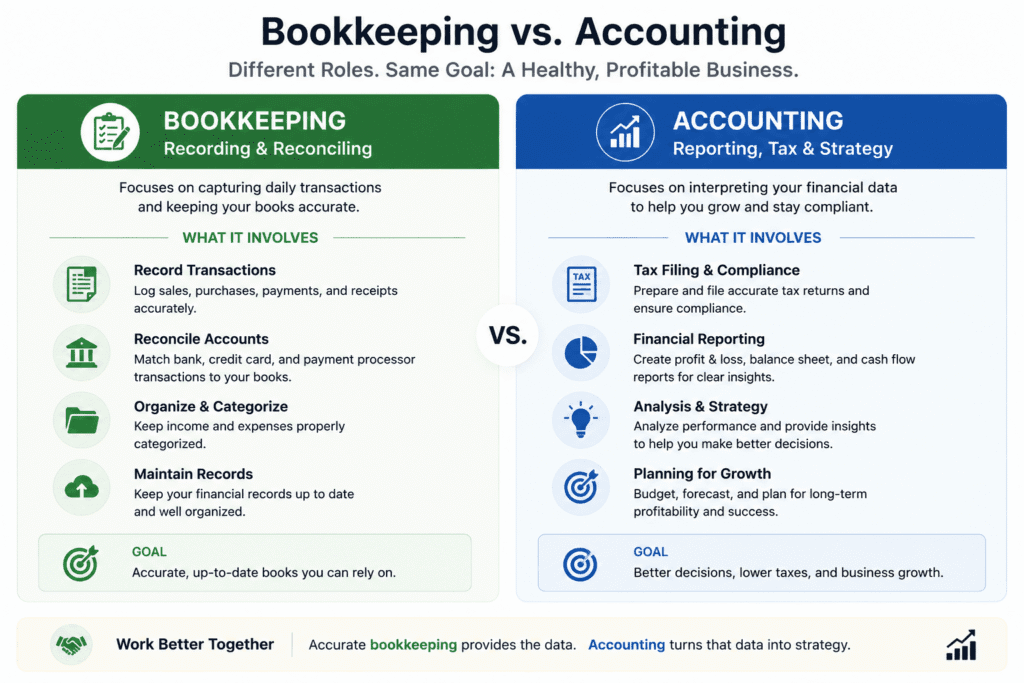
Bookkeeping is the process of recording and organizing financial transactions. It answers the question: what happened in my business?
Accounting is the process of interpreting those records to guide decisions, file taxes, and produce strategic reports. It answers the question: what does this mean, and what should I do about it?
Bookkeeping happens first. Accounting builds on top of clean bookkeeping data. Without accurate bookkeeping, accounting advice is only as good as guesswork.
Who Needs Which Service
Most e-commerce sellers need both, at different points:
- New sellers usually need bookkeeping first, to get transactions recorded and reconciled correctly
- Growing sellers need ongoing bookkeeping plus periodic accounting review for tax planning
- Sellers seeking financing or preparing to sell their business need full accounting support, including CPA-reviewed financials
A Quick Example
A bookkeeper reconciles your March transactions and confirms your Amazon and Shopify payouts match your bank deposits exactly. An accountant looks at your full-year numbers and advises you to set up an S-corp election to reduce self-employment tax. Both are valuable. Only one of them requires accurate bookkeeping data to even be possible.
Why Understanding This Difference Matters
It prevents you from paying for the wrong service. Hiring a CPA to do monthly data entry is expensive and inefficient. Hiring a bookkeeper to handle complex tax strategy leaves gaps a specialist should fill instead.
It clarifies what you should expect from each provider. A bookkeeper should deliver reconciled books and clean reports on a schedule. An accountant should deliver tax filings, strategic advice, and interpretation of what those reports mean.
It helps you scale support as your business grows. Many sellers start by doing their own bookkeeping, add a bookkeeper as volume increases, and bring in a CPA once tax complexity or financing needs arrive.
It keeps your books ready when you need accounting help. An accountant working from clean, reconciled books can give better advice faster. An accountant starting from a mess spends most of their time, and your money, fixing bookkeeping problems first.
It affects how much you pay for professional help. Bookkeeping rates are typically lower than accounting or CPA rates. Paying accounting-level fees for bookkeeping-level work is one of the most common ways sellers overspend on financial support.
Step-by-Step Guide to Deciding What You Need
Step 1: Assess Your Current Bookkeeping Accuracy
Before deciding on accounting help, confirm your bookkeeping is accurate. Check whether your bank feed is reconciled, your chart of accounts is set up correctly, and your COGS is tracked properly. Our guide on setting up a chart of accounts covers this foundation.
Step 2: Identify What Question You Are Trying to Answer
If your question is “did this transaction get recorded correctly,” that is a bookkeeping question. If your question is “how should I structure my business to reduce taxes,” that is an accounting question.
Step 3: Match the Service to Your Growth Stage
Very early-stage sellers can often manage basic bookkeeping themselves using QuickBooks Online. As order volume and sales tax obligations grow, a dedicated bookkeeper becomes worth the cost in saved time and reduced errors.
There is no single revenue number that marks this transition for every business. The better signal is time: once bookkeeping consistently takes more hours than the seller can reasonably spare from running the business, it is time to hand it off.
Step 4: Bring in Accounting Support at Key Milestones
Consider accounting support when you cross a new sales tax nexus threshold, prepare for your first significant tax filing, apply for financing, or consider selling the business. These moments benefit from strategic interpretation, not just clean records.
Step 5: Confirm Your Bookkeeping Is Audit-Ready First
Before any major accounting milestone, make sure your bookkeeping can withstand scrutiny. Our catch-up bookkeeping service exists specifically for sellers who need to bring months or years of records up to date before moving forward.
Step 6: Choose Providers Who Work Well Together
If you use separate providers for bookkeeping and accounting, make sure they communicate. A bookkeeper who understands what your accountant needs at tax time saves both time and money for you.
Ask whether your bookkeeper can export reports in the format your accountant prefers, and whether your accountant will flag bookkeeping issues they notice during tax prep rather than just working around them silently.
Practical Tips for Better Results
Do not wait until tax season to fix bad bookkeeping. Cleaning up a full year of disorganized records under a filing deadline costs more and creates more stress than addressing it monthly.
Ask providers directly what they include. “Bookkeeping” and “accounting” mean different things to different firms. Confirm exactly what is included, whether that is monthly reconciliation, tax filing, or both, before signing on.
Keep your systems consistent. Whether you handle bookkeeping yourself or hire it out, use the same chart of accounts and accounting method every month so an accountant can step in cleanly when needed.
Review the 7 most common accounting mistakes. Many of the errors that create expensive accounting cleanup work are avoidable. See our guide on common accounting mistakes small businesses make to spot them early.
Know that platform reconciliation is a bookkeeping specialty. Amazon and Shopify bookkeeping requires familiarity with tools like A2X, not just general bookkeeping knowledge. A general bookkeeper unfamiliar with e-commerce platforms may miss fee and refund detail a specialist would catch immediately.
A common mistake is assuming your tax preparer is also handling your bookkeeping throughout the year. Many tax preparers only touch your books once, at filing time, which means monthly errors go uncaught for months.
Conclusion
Bookkeeping and accounting solve different problems. Bookkeeping keeps your records accurate day to day. Accounting turns those records into tax filings, strategy, and decisions. Most e-commerce businesses need both, but rarely need them from the same source at the same intensity.
Start by making sure your bookkeeping foundation is solid. Everything accounting builds on top of it depends on that accuracy. Our full e-commerce bookkeeping guide walks through exactly how to build that foundation, step by step.
Not sure whether you need a bookkeeper, an accountant, or both? Book a free consultation and we will help you figure out exactly what your business needs right now.
By:

Ashfaq helps e-commerce business owners turn messy numbers into clear, reliable financials. With over 15 years of experience, he specializes in bookkeeping for Amazon and Shopify sellers, ensuring accuracy, clarity, and confident decision-making.
Categories
Latest Posts
- August 2, 2026
Amazon Seller Connector by QuickBooks: Complete Guide
- July 21, 2026
How COGS Accounting Works for Canadian FBA Sellers
Tags
A2X
Accounting Method
Amazon FBA
Amazon Marketplace Connector
Amazon Seller Central
Amazon Seller Connector
Bookkeeping Tips
Canada Tax Registration
Canadian Bookkeeping
Canadian Sales Tax
Chart of Accounts
COGS
E-Commerce
E-Commerce Bookkeeping
Finance
Financial Statements
GST/HST
Inventory
Payout Reconciliation
Profit and Loss
QuickBooks Online
Sales Tax
Sales Tax Compliance
Shopify
TaxCloud